


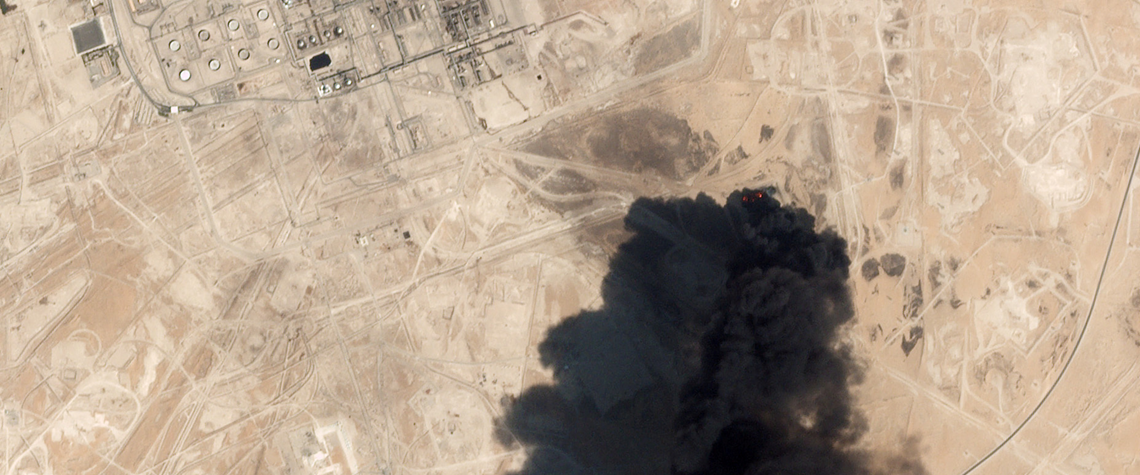
A satellite image shows a drone strike on an Aramco oil facility in Abqaiq, Saudi Arabia
Oil and trouble in the Gulf
Gulf producers learn that regional instability no longer guarantees high oil prices
The September attacks on Saudi Aramco’s Abqaiq processing plant and Khurais oil field—which took out about half the kingdom’s production—was the most serious in a string of destabilising developments in the Middle East during the summer and early autumn: the seizure of oil tankers; attacks on tankers; the sacking of the Saudi oil minister; riots in Iraq and Egypt; an acceleration of Iranian uranium enrichment; the Turkish invasion of northern Syria. Under normal circumstances, any one of these events could have triggered a prolonged spike in oil prices. After the Abqaiq/Khurais attacks, the price rose by about 20pc, but not for long. The average Brent spot price for that week was just over

Also in this section
21 April 2026
After overcoming a COVID-induced demand collapse with several years of successful market management, geopolitical events have conspired to provide the pact’s biggest test to date
21 April 2026
The regime’s policy of using nuclear ambiguity as a deterrent may have failed but it has realised it has other cards to play, while its neighbours are reappraising their approach to security
21 April 2026
As the global energy system undergoes a fundamental realignment, Algihaz Holdings has established itself as a critical player bridging conventional energy markets and the next generation of renewable infrastructure.
21 April 2026
The 25th WPC Energy Congress is taking place from 11-15 October 2026 at the Riyadh Front Exhibition & Conference Center.



