


Newsletters | Request Trial | Log in | Advertise | Digital Issue   |   Search
  • Upstream
  • Midstream & Downstream
  • Gas & LNG
  • Trading & Markets
  • Corporate & Finance
  • Geopolitics
  • Podcasts
Search
Related Articles
Accelerating MENA’s gas transformation
Gas has become a pillar of MENA economies and a catalyst for development strategies, fostering cooperation and creating new paths for economic diversification. Continued progress will require substantial investment and adapted regulations
MENA states try to change their gas fortunes
While Syria has gas import plans and Jordan is targeting greater production, Egypt is struggling with declining output and Lebanon with the after-effects of conflict
MENA states sharpen their gas focus
The GCC countries and other states in the region are looking to make greater domestic use of gas, both that produced at home and imported volumes
Mideast states power up their gas priorities
Saudi Arabia, the UAE and Qatar are ploughing resources into gas—with a growing eye on facilitating domestic use in power and value-added sectors
Natural gas: A vital bridge for the Middle East’s energy future
With responsible development and rigorous regulation, gas can help the region move forward not just as an energy exporter, but as a global leader in the energy transition
MENA's gas metamorphosis
Across the Middle East and North Africa, gas is taking an enhanced role in helping build out economies that need to diversify away from crude oil dependence
Fear and loathing in US LNG buildout
Overall gas optimism is blighted by concerns over lingering regulatory and infrastructure hurdles that could hamper expansion of US LNG exports, weaken security and stifle AI ambitions
Middle East doubling down on oil strength
Saudi Arabia, the UAE, Iraq and Kuwait aim to turn geological advantage into sustained geopolitical power via greater spare capacity
Deepwater’s race against time
E&Ps are on the lookout for the next big deepwater discovery amid questions over the Guyana and Santos basins, but technological advancements provide optimism
US sees energy dominance as strategic necessity
The Trump administration is using energy exports to strengthen political and economic ties with allies and weaken adversaries, while simultaneously exploiting those ties to open up further markets for US energy
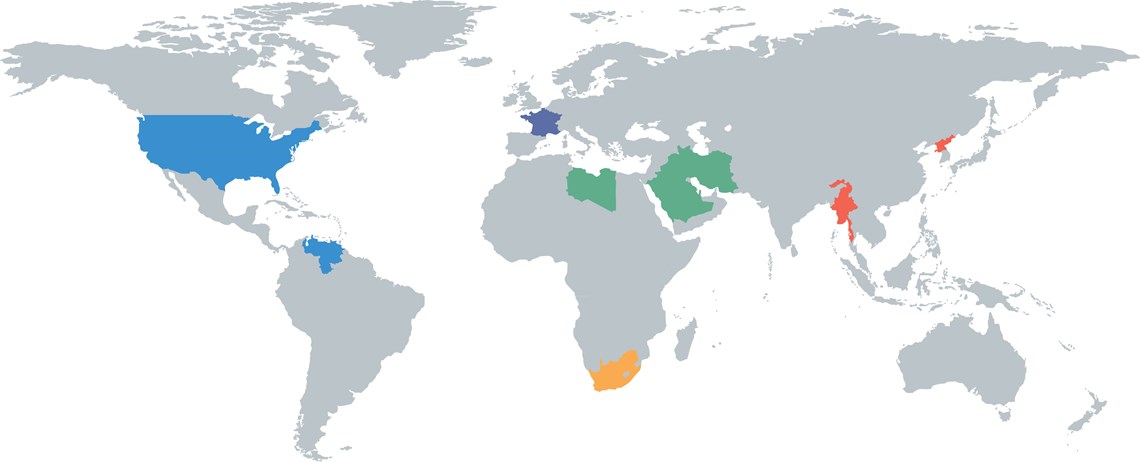
US Venezuela Libya France South Africa Saudi Arabia Iraq Iran Myanmar Korea
23 January 2018
Follow @PetroleumEcon
Forward article link
Share PDF with colleagues

Volatile world

Trump ditched Paris, Paris got Macron, Isis lost Mosul

America On 1 June, President Donald Trump fulfilled one of his election promises by pulling the US out of the Paris Accord on climate change. He said the agreement had put America at a "very, very big economic disadvantage". The move was widely criticised. Later in the year parts of the US and nearby islands were battered by a larger-than-normal number of hurricanes and tropical storms—a clear sign, many said, of climate change. Earlier in the year, Trump's "America First" plan saw him pull the US out of the Trans-Pacific Partnership. He maintained throughout 2017 that he could do the same with Nafta too. Venezuela President Nicolás Maduro spent the year tightening his grip on power and cast

Also in this section
Germany under pressure to solve Rosneft refinery problem
7 November 2025
The Russian company’s German assets are under Berlin’s management and are exempt from sanctions, for now, but a permanent solution still needs to be found
Lukoil loses its growth prospects
6 November 2025
The Russian firm made a significant attempt to expand overseas over the past two decades but is now divesting its global operations
Letter from Europe: Western retreat raises doubts over climate leadership
Opinion
6 November 2025
After years of pursuing ideologically driven climate leadership, Western powers are now stepping back under mounting political pressure and rising populist opposition—prompting concern essential climate action could be sidelined
Turkmenistan's pipe dream
5 November 2025
Construction of the pipeline in Afghanistan is making tangible progress, but extending it into Pakistan and India remains unrealistic for political reasons

Share PDF with colleagues

COPYRIGHT NOTICE: PDF sharing is permitted internally for Petroleum Economist Gold Members only. Usage of this PDF is restricted by <%= If(IsLoggedIn, User.CompanyName, "")%>’s agreement with Petroleum Economist – exceeding the terms of your licence by forwarding outside of the company or placing on any external network is considered a breach of copyright. Such instances are punishable by fines of up to US$1,500 per infringement
Send

Forward article Link

Send
Sign Up For Our Newsletter
Project Data
Maps
Podcasts
Social Links
Featured Video
Home
  • About us
  • Subscribe
  • Reaching your audience
  • PE Store
  • Terms and conditions
  • Contact us
  • Privacy statement
  • Cookies
  • Sitemap
All material subject to strictly enforced copyright laws © 2025 The Petroleum Economist Ltd
Cookie Settings
;

Search


