


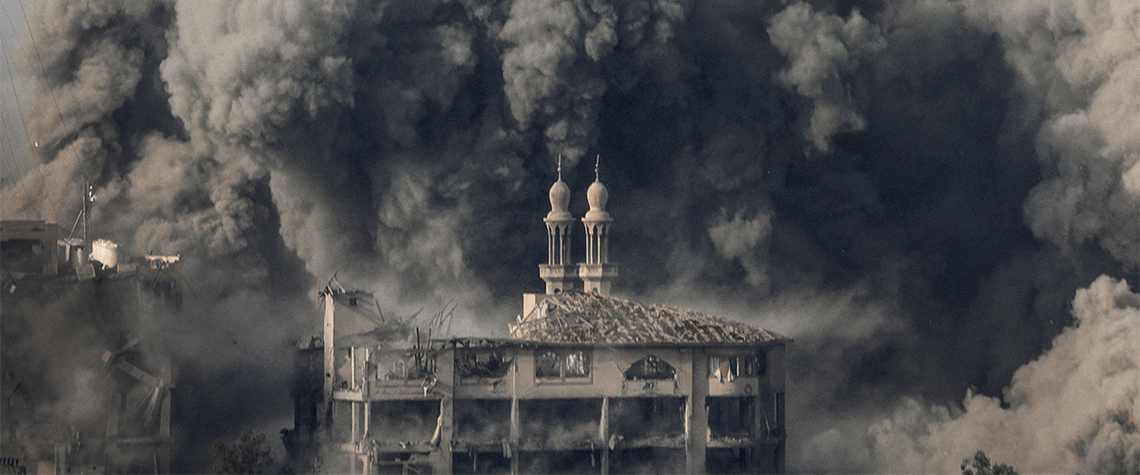
An Israeli strike in Gaza City
Israel-Hamas war clouds energy prospects
The threat of a big disruption to energy trade in the Middle East appears to be receding, but the fog of war is casting doubt on projects in the region
The war in Gaza may still escalate beyond the borders of Israel and the Palestinian territories and cause major energy disruptions, but the likelihood of this appeared to have receded by early December as a ceasefire came and went and hostilities remained largely constrained to the Gaza Strip and surrounding areas. Instead, experts say, different tracks of negotiations are picking up, with the entire Middle East in flux and Qatar’s status in particular elevated—as both an energy powerhouse and a geopolitical deal maker. Global oil and gas prices spiked immediately after the surprise attack by Hamas on 7 October, which claimed more than 1,200 Israeli lives and disrupted regional energy trade.

Also in this section
21 April 2026
After overcoming a COVID-induced demand collapse with several years of successful market management, geopolitical events have conspired to provide the pact’s biggest test to date
21 April 2026
The regime’s policy of using nuclear ambiguity as a deterrent may have failed but it has realised it has other cards to play, while its neighbours are reappraising their approach to security
21 April 2026
As the global energy system undergoes a fundamental realignment, Algihaz Holdings has established itself as a critical player bridging conventional energy markets and the next generation of renewable infrastructure.
21 April 2026
The 25th WPC Energy Congress is taking place from 11-15 October 2026 at the Riyadh Front Exhibition & Conference Center.



