


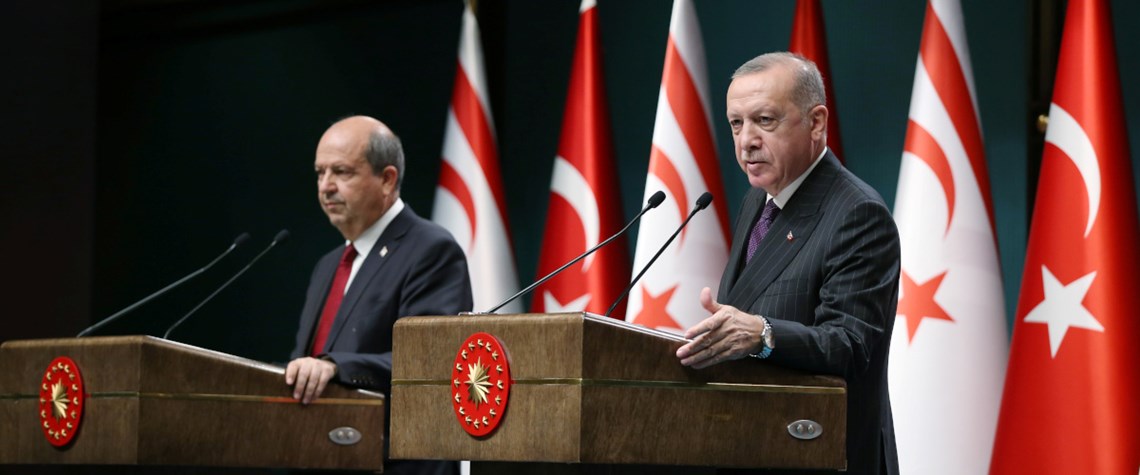
TRNC president Ersin Tatar (left) with Erdogan
Election blow to Cyprus gas prospects
The emergence of a new Turkish Cypriot leader with close ties to Ankara is likely to worsen offshore tensions
A mid-October election in the tiny self-declared state of Northern Cyprus—recognised only by Turkey—is not, in global terms, a major event. But the outcome could have a significant impact on the future of the island and the exploitation of hydrocarbons in Cypriot waters. The successful candidate and new president of the breakaway Turkish Republic of Northern Cyprus (TRNC), Ersin Tatar, is a nationalist with strong support from Turkey’s president Recep Tayyip Erdogan. Unlike Tatar’s predecessor, who backed the idea of Cyprus being reunified on a federal basis, the new incumbent favours a two-state solution. “We deserve our sovereignty and our independence,” he says. Overnight, one side in the

Also in this section
1 April 2026
Golden Pass’s startup offers QatarEnergy a timely boost but may also force a difficult choice between honouring disrupted contracts and capitalising on soaring spot LNG prices
1 April 2026
It is not a case of if or when, but the length and magnitude of economic damage from elevated oil prices
1 April 2026
The US-Iran conflict demonstrates the need for diversification in several senses of the word. It also exposes the limits of Washington applying pressure on major oil and gas producers it considers geopolitical adversaries
31 March 2026
Disappointing results in its bidding round are a reality check for Libya, and global exploration generally



