


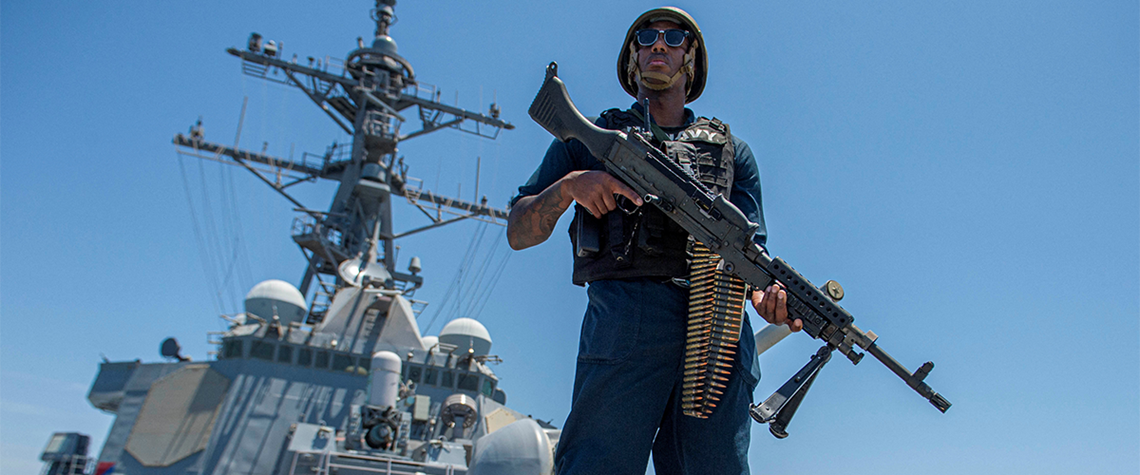
A soldier stands on the guided-missile destroyer USS Paul Hamilton in the Strait of Hormuz
Shipping shrugs off Hormuz Strait incidents
Despite contradictory claims of increased tensions in Mideast Gulf waters and possible rapprochement between the US and Iran, the situation appears business as usual for freight
Washington and Tehran are once again in talks. The discussions are not public but likely address issues such as prisoners, regional conflicts and tensions, the US-led sanctions on Iran and the Islamic Republic’s a ambitions. And while the enmity between the two countries might seem impossible to bridge, the two parties were able to reach a wide-ranging accommodation relatively recently. The 2015 JCPOA deal loosened sanctions in exchange for Iran halting its nuclear projects, although of course that deal was subsequently scrapped when the Republicans retook the White House. But for a brief window while the JCPOA was in place, Iranian crude flowed into the market, including deliveries to Europ

Also in this section
1 April 2026
Golden Pass’s startup offers QatarEnergy a timely boost but may also force a difficult choice between honouring disrupted contracts and capitalising on soaring spot LNG prices
1 April 2026
It is not a case of if or when, but the length and magnitude of economic damage from elevated oil prices
1 April 2026
The US-Iran conflict demonstrates the need for diversification in several senses of the word. It also exposes the limits of Washington applying pressure on major oil and gas producers it considers geopolitical adversaries
31 March 2026
Disappointing results in its bidding round are a reality check for Libya, and global exploration generally



