


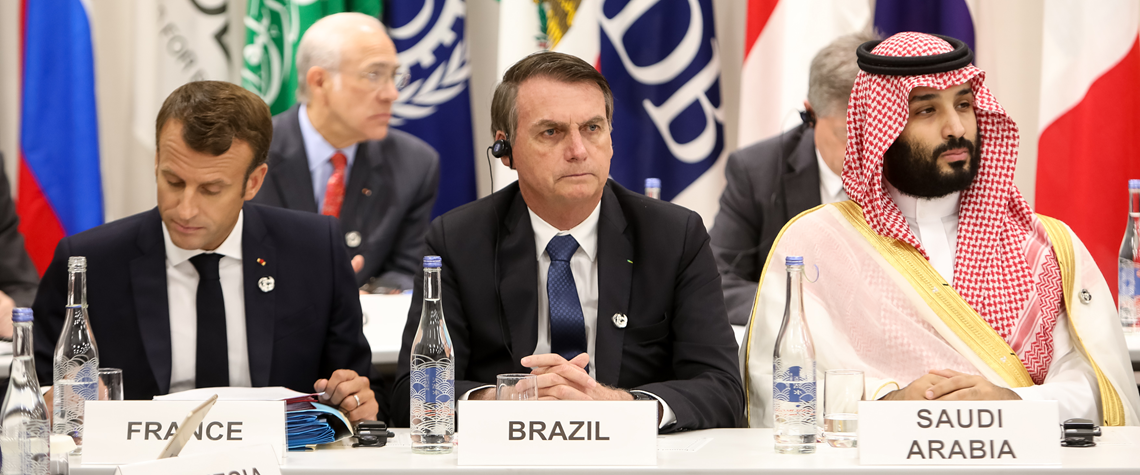
Prince Mohammed (far right) at the 2019 G20 Osaka summit
More bad signs for MbS
Sub-$60/bl Brent, a rising budget deficit, soft foreign direct investment and subdued growth in the non-oil sector all drag on Vision 2030
Saudi Arabia's crown prince Mohammad Bin Salman, or MbS, as he is known, has made his Vision 2030 programme to modernise the Saudi Arabian economy by reducing oil dependency a flagship policy. But recent developments suggest the headwinds it is facing are growing stronger, rather than the promised transformation growing any momentum. Currently, oil and gas sales account for 30pc of Saudi GDP, government consumption and investment— including government stimulus and petrochemical investment—account for around 34pc, while just 36pc is contributed by the private sector. Under Vision 2030, the aim is to raise the share of private non-oil revenues to 65pc by 2030. For that to happen, non-oil priva

Also in this section
1 April 2026
Golden Pass’s startup offers QatarEnergy a timely boost but may also force a difficult choice between honouring disrupted contracts and capitalising on soaring spot LNG prices
1 April 2026
It is not a case of if or when, but the length and magnitude of economic damage from elevated oil prices
1 April 2026
The US-Iran conflict demonstrates the need for diversification in several senses of the word. It also exposes the limits of Washington applying pressure on major oil and gas producers it considers geopolitical adversaries
31 March 2026
Disappointing results in its bidding round are a reality check for Libya, and global exploration generally



