


Newsletters | Request Trial | Log in | Advertise | Digital Issue   |   Search
  • Upstream
  • Midstream & Downstream
  • Gas & LNG
  • Trading & Markets
  • Corporate & Finance
  • Geopolitics
  • Podcasts
Search
Related Articles
Letter from Asia: The nuanced India-Russia oil picture
The South Asian consumer’s next move could tighten the Middle East oil market overnight
Indian refiners prove their adaptability
A strategic pivot away from Russian crude in recent weeks tees up the possibility of improved US-India trade relations
India’s refining project strengthens ties to Mongolia
The Central Asian country’s first oil refinery is being funded by a $1.7b line of credit from New Delhi, but routes in and out of the country remain controlled by Russia and China
Turkmenistan's pipe dream
Construction of the pipeline in Afghanistan is making tangible progress, but extending it into Pakistan and India remains unrealistic for political reasons
India’s LNG falling short
More needs to be done to meet the government’s ambitious targets for gas
India’s retreat from Russian oil could cause global trade flow shockwaves
US secondary sanctions are forcing a rapid reassessment of crude buying patterns in Asia, and the implications could reshape pricing, freight and supply balances worldwide. With India holding the key to two-thirds of Russian seaborne exports, the stakes could not be higher
Middle East gas can power regional prosperity
The Middle East natural gas playbook is being rewritten. The fuel source offers the region a pathway to a cleaner, sustainable and affordable means of local power, to fasttrack economic development and as a lucrative opportunity to better monetise its energy resources.
TotalEnergies sticks to winning formula
TotalEnergies is an outlier among other majors for remaining committed to low-carbon investments while continuing to replenish and expand its ample oil and gas portfolio, with an appetite for high risk/high return projects.
Canada enters the global LNG race
Owing to social, political and geographical factors, Canadian LNG projects are a complex proposition versus competing facilities on the US Gulf of Mexico
India’s Nayara fallout
The EU’s Russia sanctions could have far-reaching implications for India’s Vadinar-based refinery
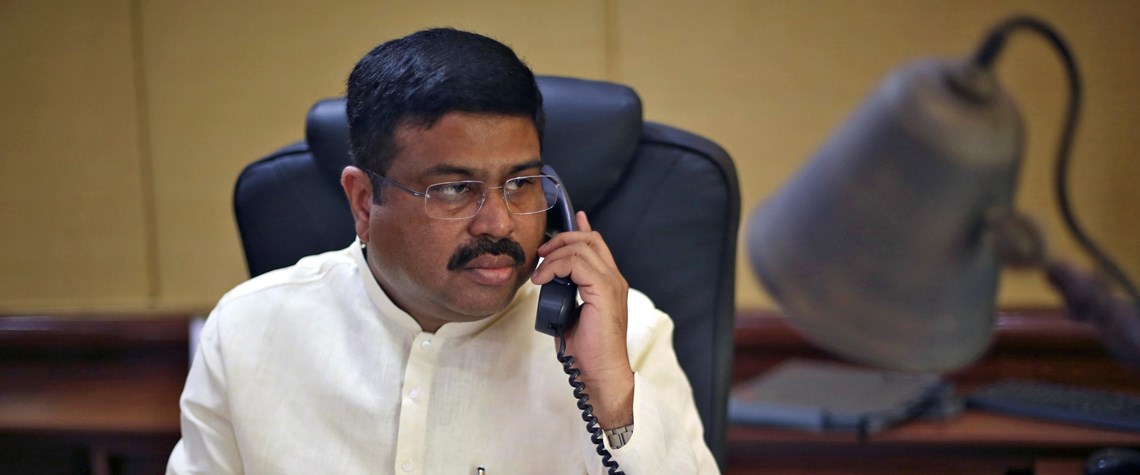
India's Oil Minister Pradhan on a phone interview
India Natural gas LNG trading
Alex Forbes
28 January 2020
Follow @PetroleumEcon
Forward article link
Share PDF with colleagues

India’s ‘blue flame revolution’ gathers pace

Natural gas will play a pivotal role in underpinning the world’s fastest-growing major economy as the government grapples with its energy trilemma—to make its supply secure, affordable and sustainable

During the first term of Narendra Modi’s National Democratic Alliance (NDA) government, the prime minister and his petroleum and natural gas minister, Dharmendra Pradhan, spoke often of wanting to build a gas-based economy in India. Pradhan says he wants to see a “blue flame revolution transform India’s energy landscape”.  With the government now in its second term—following the NDA’s landslide victory in last May’s general election—gas remains a policy priority. The aim is to boost the share of natural gas in primary energy supply from 6.2pc to 15pc by 2030. Given that primary energy supply is forecast to grow by 4.2pc/year, according to Pradhan, the scale of this ambition is breathtaking.

Also in this section
Navigating the next LNG cycle
10 March 2026
Eni’s director for global gas and LNG portfolio, Cristian Signoretto, discusses how demand will respond to rising LNG supply, and how the company is expanding its own gas and LNG operations through disciplined, capital-efficient investments
OPEC+ boosted production before crisis
9 March 2026
Petroleum Economist analysis sees increases in output from Saudi Arabia, Venezuela and Kazakhstan among others before region’s murky descent
Energy dominance as diplomatic leverage
9 March 2026
Energy sanctions are becoming an increasingly prominent tool of US foreign policy, with the country’s growth in oil and gas production allowing it to impose pressure on rivals without jeopardising its own energy security or that of its allies, argues Matthew McManus, a visiting fellow at the National Center for Energy Analytics
Petroleum Economist: March 2026
6 March 2026
The March 2026 issue of Petroleum Economist is out now!

Share PDF with colleagues

COPYRIGHT NOTICE: PDF sharing is permitted internally for Petroleum Economist Gold Members only. Usage of this PDF is restricted by <%= If(IsLoggedIn, User.CompanyName, "")%>’s agreement with Petroleum Economist – exceeding the terms of your licence by forwarding outside of the company or placing on any external network is considered a breach of copyright. Such instances are punishable by fines of up to US$1,500 per infringement
Send

Forward article Link

Send
Sign Up For Our Newsletter
Project Data
Maps
Podcasts
Social Links
Featured Video
Home
  • About us
  • Subscribe
  • Reaching your audience
  • PE Store
  • Terms and conditions
  • Contact us
  • Privacy statement
  • Cookies
  • Sitemap
All material subject to strictly enforced copyright laws © 2025 The Petroleum Economist Ltd
Cookie Settings
;

Search


