


Newsletters | Request Trial | Log in | Advertise | Digital Issue   |   Search
  • Upstream
  • Midstream & Downstream
  • Gas & LNG
  • Trading & Markets
  • Corporate & Finance
  • Geopolitics
  • Podcasts
Search
Related Articles
Letter from Saudi Arabia: US-Saudi energy ties enter a new phase
Aramco’s pursuit of $30b in US gas partnerships marks a strategic pivot. The US gains capital and certainty; Saudi Arabia gains access, flexibility and a new export future
Letter from London: Oil’s golden triangle
The interplay between OPEC+, China and the US will define oil markets throughout 2026
The curious case of oil-on-water
The market is facing being drowned in excess crude, but one caveat is that a large chunk is due to buyers reluctant to snap up sanctioned barrels
The duality of US shale
A sector beset by pessimism and pain amid price weakness contrasts with data signalling production strength and resilience
Accelerating MENA’s gas transformation
Gas has become a pillar of MENA economies and a catalyst for development strategies, fostering cooperation and creating new paths for economic diversification. Continued progress will require substantial investment and adapted regulations
MENA states sharpen their gas focus
The GCC countries and other states in the region are looking to make greater domestic use of gas, both that produced at home and imported volumes
Fear and loathing in US LNG buildout
Overall gas optimism is blighted by concerns over lingering regulatory and infrastructure hurdles that could hamper expansion of US LNG exports, weaken security and stifle AI ambitions
Middle East doubling down on oil strength
Saudi Arabia, the UAE, Iraq and Kuwait aim to turn geological advantage into sustained geopolitical power via greater spare capacity
Deepwater’s race against time
E&Ps are on the lookout for the next big deepwater discovery amid questions over the Guyana and Santos basins, but technological advancements provide optimism
US sees energy dominance as strategic necessity
The Trump administration is using energy exports to strengthen political and economic ties with allies and weaken adversaries, while simultaneously exploiting those ties to open up further markets for US energy
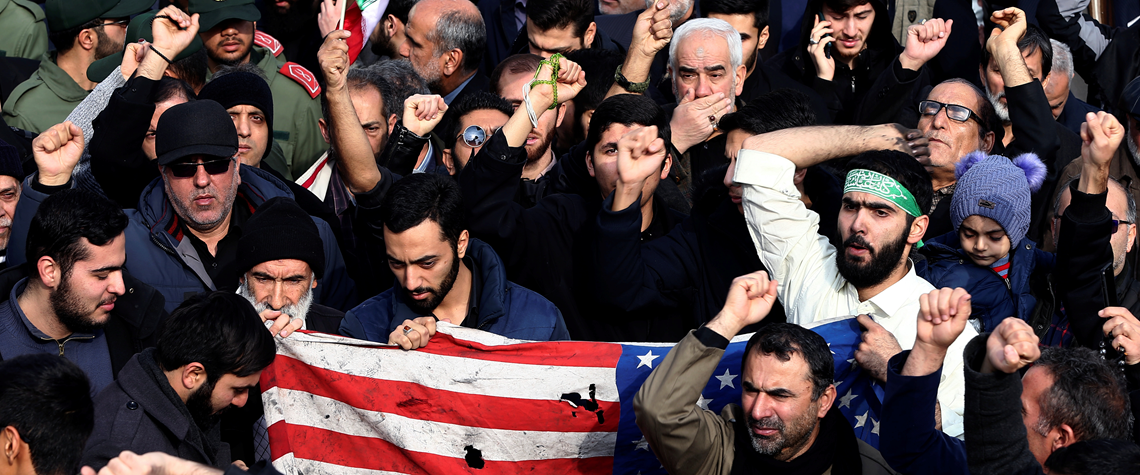
Demonstrators attend a protest against the assassination of the Iranian Major-General Qassem Soleimani in Tehran
Iraq Iran US
Gerald Butt
3 January 2020
Follow @PetroleumEcon
Forward article link
Share PDF with colleagues

US lobs a grenade into a box of fireworks

Washington and Tehran may consider their next moves after drone kills top Iranian general, but restraint is the likeliest casualty

The long-rumbling US-Iran crisis has moved to a new and extremely febrile phase, after the US took out General Qassem Soleimani, Iran’s top commander in Iraq, in a targeted attack at Baghdad airport.  For months, tension has been high in the Mid-East Gulf—with attacks on shipping, on Saudi oil facilities and on other infrastructure. Iraq, where both the US and Iran have strong interests and strong allies, has been a particular focus in recent weeks. Against the background of a serious domestic political crisis, Iran-back militias attacked US facilities in the country, which appears to have sparked the fierce American response.  While the US and Iran had previously been careful to prevent mat

Also in this section
Learning from oil’s supercycle miss
5 December 2025
Mistaken assumptions around an oil bull run that never happened are a warning over the talk of a supply glut
Explainer: What do Russia’s oil giants own overseas?
4 December 2025
Time is running out for Lukoil and Rosneft to divest international assets that will be mostly rendered useless to them when the US sanctions deadline arrives in mid-December
Letter from Saudi Arabia: US-Saudi energy ties enter a new phase
Opinion
3 December 2025
Aramco’s pursuit of $30b in US gas partnerships marks a strategic pivot. The US gains capital and certainty; Saudi Arabia gains access, flexibility and a new export future
Letter from London: Oil’s golden triangle
Opinion
2 December 2025
The interplay between OPEC+, China and the US will define oil markets throughout 2026

Share PDF with colleagues

COPYRIGHT NOTICE: PDF sharing is permitted internally for Petroleum Economist Gold Members only. Usage of this PDF is restricted by <%= If(IsLoggedIn, User.CompanyName, "")%>’s agreement with Petroleum Economist – exceeding the terms of your licence by forwarding outside of the company or placing on any external network is considered a breach of copyright. Such instances are punishable by fines of up to US$1,500 per infringement
Send

Forward article Link

Send
Sign Up For Our Newsletter
Project Data
Maps
Podcasts
Social Links
Featured Video
Home
  • About us
  • Subscribe
  • Reaching your audience
  • PE Store
  • Terms and conditions
  • Contact us
  • Privacy statement
  • Cookies
  • Sitemap
All material subject to strictly enforced copyright laws © 2025 The Petroleum Economist Ltd
Cookie Settings
;

Search


