

Carbon sits at the centre of the climate challenge. For two centuries, it has powered industrial growth, raised living standards around the world and underpinned the materials and fuels that modern economies rely on. Yet it is the element we must now manage most carefully if the global economy is to reach net zero.
The Energy Transitions Commission and Systemiq’s latest work, Carbon in an Electrified Future, explores how carbon can be reduced, used, sourced and disposed of at end-of-life within a sustainable global system, reframing it as a finite resource to be stewarded with the same discipline as energy, land and water.
Carbon in an electrified system
Even in a deeply electrified economy, carbon will not disappear. The power sector has seen one of the largest transformations to date, with solar and wind generation outpacing electricity demand growth in the first half of 2025. Clean electricity and hydrogen are expected to displace fossil fuels across transport, buildings and heavy industry.
Last year, electric vehicles displaced more than 1m b/d of oil demand and made up 20% of new car sales worldwide. Yet some uses of carbon cannot easily be substituted, such as producing chemicals and plastics and providing energy for aviation, where dense, energy-rich fuels are essential. A shift is required to ensure residual carbon use aligns with climate goals by shifting from today’s linear, emission-intensive model to a managed cycle in which carbon is sustainably sourced, circulates through the economy and is safely stored at end-of-life. This change requires new technology, incentives and infrastructure that recognise carbon’s enduring role and constrain its impacts.
Building circularity into the carbon system
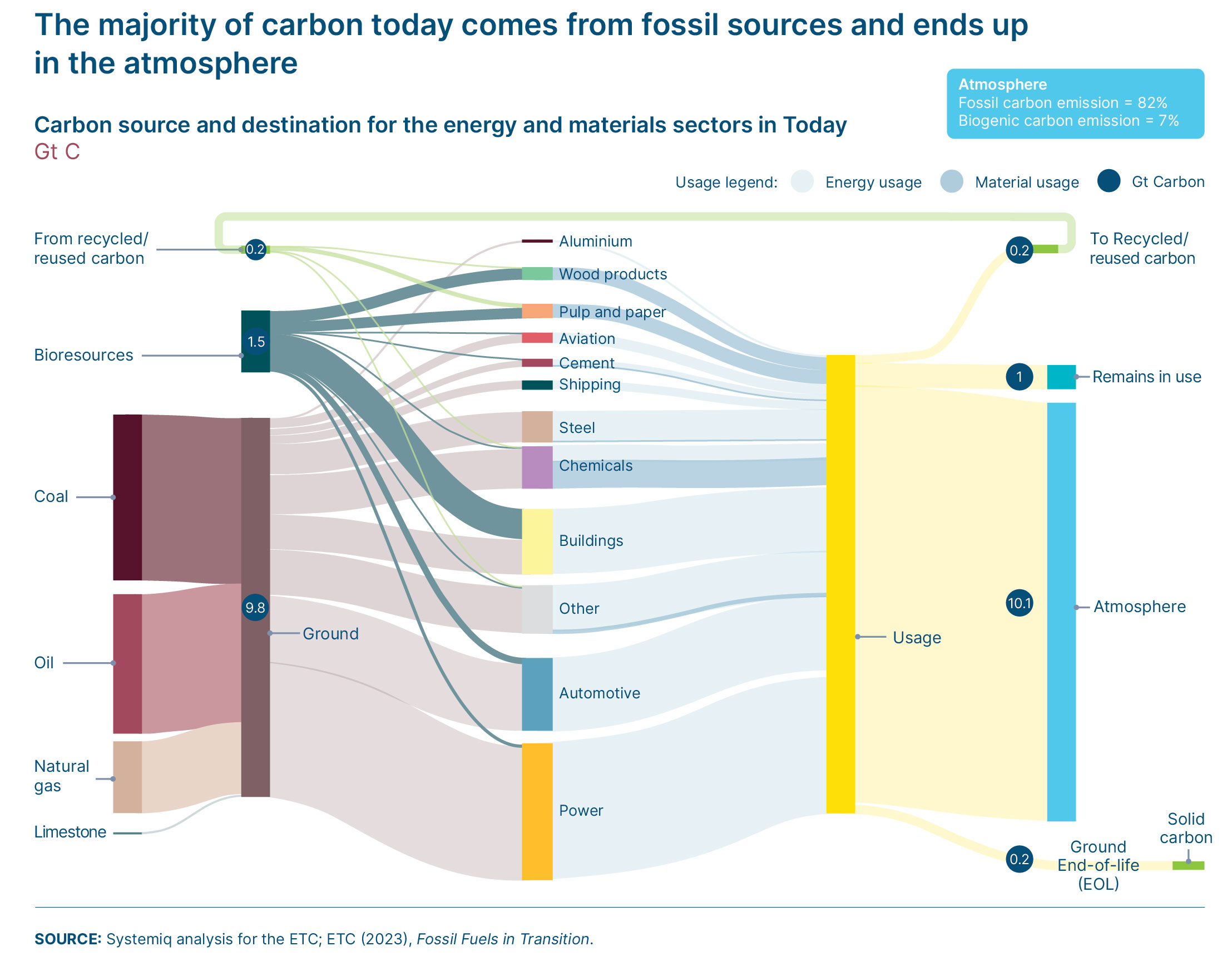
Today, most carbon used in the energy and materials sectors comes from fossil sources and is released into the atmosphere after a single use. Circularity can reduce primary carbon demand, limit waste and lower pressure on natural ecosystems.
Many solutions already exist. Mechanical recycling, product-reuse models and better design standards can keep carbon in circulation. Advanced technologies such as chemical recycling (material-to-material) and carbon utilisation (CO₂- or CO-to-fuel, chemicals or materials) are emerging where others, such as mechanical routes, reach their limits. These options are complementary rather than competing, forming the foundation for a more efficient and lower-emission materials and energy economy.
For policymakers, the task is to remove barriers and create coherence across value chains. Product standards, extended producer responsibility, carbon accounting and investment in collection and processing infrastructure can turn existing potential into scaled outcomes.
Sourcing carbon responsibly
Even with extensive recycling, some carbon will always need to be newly sourced, and it must come from sustainable origins. Biomass, captured carbon from industrial processes, and emerging approaches such as direct air capture or ocean-based removal can play a role. However, each has cost, energy and environmental trade-offs that vary by source, country and sector.
Strong governance is essential: land-use and biodiversity standards must guide biomass, and robust regulatory and monitoring systems must underpin carbon capture. Innovation policy should accelerate early-stage technologies while setting clear ecological safeguards. The aim is not to pick winners but to set boundaries within which responsible carbon sourcing can thrive.
Managing carbon at the end of life
Even in the most efficient circular system, some carbon will reach an endpoint. Permanent storage is therefore an essential part of the transition. Geological storage and mineralisation can lock carbon safely out of the atmosphere, while engineered landfill solutions can manage solid carbon from waste streams. These options must be strictly governed to ensure permanence and avoid local environmental risks. Governments now need to accelerate the development of these storage solutions and support viable business models that make permanent carbon management scalable and investable.
Carbon storage is not a licence for ongoing emissions, but it closes the loop for the carbon that cannot yet be reused. Policy must ensure these measures complement ongoing efforts to reduce demand and improve efficiency.
From technology lists to system design
Too often, the carbon debate is framed around individual technologies. A systems approach is needed. The technologies are tools, while the system determines how they interact, how resources flow and how value is created. Designing that system means joining up the decisions that shape how carbon moves, from power generation to industrial production and waste. Clean electricity affects hydrogen; land-use rules shape sustainable biomass; and product and waste policy decide whether carbon is reused or released.
Markets alone will not deliver this shift. Carbon pricing helps, but governments and investors must prioritise the enabling infrastructure; clean power, CO₂ transport and storage, and material recovery that allow technologies to function as a coherent system. Companies can reinforce this by redesigning products and value chains for circularity and adopting credible accounting for embedded carbon.
A new mindset for the net-zero economy
The heart of the issue is cultural as much as technical. For over a century, carbon was treated as limitless. It should be treated as precious. Every molecule should have a provenance, a purpose and a plan for where it goes next. This shift in perspective transforms the carbon challenge from a constraint into a design principle.
Managing carbon well will determine whether emissions fall fast and steep enough, and industries adapt without compromising growth and resilience. With the right policies and investments, carbon stewardship can become a source of innovation, competitiveness and global cooperation—building a more balanced and durable economy for the century ahead.
Andrea Bath is head of low carbon fuels at the Energy Transitions Commission and project manager, low-carbon energy platforms, at Systemiq.




Comments